
Give us a missed call
6235 400 400



Cumulative vs. Non-Cumulative Fixed Deposits: Which One is Right for You?
A cumulative FD lets your money grow through compounding, with a lump sum paid at maturity. A non-cumulative FD pays interest at regular intervals like monthly, quarterly, half-yearly, or annually. Muthoot Capital offers both options.
The Question Nobody Asks Until It Is Too Late
You finally decide to open fixed deposit online. You have the money. You have the discipline. And then the form asks: Cumulative or Non-Cumulative?
Most people stare at this for a few seconds, shrug, and pick one at random. Or worse — they pick whichever sounds more familiar.
That one choice determines whether your FD quietly grows into a larger corpus over time, or whether it pays you regular interest every month. Two very different outcomes. Same product. Same rate. Different structure.
This is not complicated. But it does require you to understand what each type actually does — and more importantly, what kind of investor you are right now.
The Real Problem: Picking Based on Vibes, Not Math
Here is what happens in most cases:
- A retiree picks a cumulative FD because the maturity amount looks impressive on paper — and then struggles with monthly cash flow for five years.
- A salaried professional picks a non-cumulative FD for the monthly payout — but does not actually need that income and ends up spending the interest instead of compounding it.
- Someone in their 30s locks money into the wrong FD type for their goal horizon and loses thousands of rupees in foregone compounding.
None of these people made a bad decision because they lacked intelligence. They made it because no one clearly explained what both options do at the structural level. So here is the full picture.
What is a Cumulative Fixed Deposit?
In a cumulative FD, your interest is not paid out and is added back to your principal at the end of each compounding cycle — quarterly, in most cases.
This creates compounding: you earn interest on your interest. By the time the FD matures, you receive a single lump-sum amount that is higher than what a non-cumulative FD of the same amount and tenure would have generated.
Who should use it:
- Salaried individuals who do not need a supplemental monthly income
- Young investors building a corpus for a specific goal — education, a vehicle purchase, a house down payment
- Anyone who has the discipline not to touch the money mid-tenure
- The key principle here is simple: if you do not need the money periodically, do not take it out.
What is a Non-Cumulative FD?3
With a non-cumulative FD, you get periodic interest payments during your FD tenures. Your principal stays locked in until maturity. Only the interest is paid out. Because the interest is being distributed rather than reinvested, the total returns at maturity are slightly lower than a cumulative FD at the same rate.
Who should use it:
- Retired individuals using FD interest to cover monthly household expenses
- Homemakers or dependents who need a predictable income stream
- Freelancers or self-employed individuals who want to smooth out income irregularity
- Anyone supplementing a Muthoot Loan EMI or other recurring financial commitment
The trade-off is clear: you get liquidity and predictability in exchange for slightly lower total returns. For someone who genuinely needs that monthly or quarterly payout, this trade-off makes complete sense.
Cumulative vs. Non-Cumulative: Side by Side
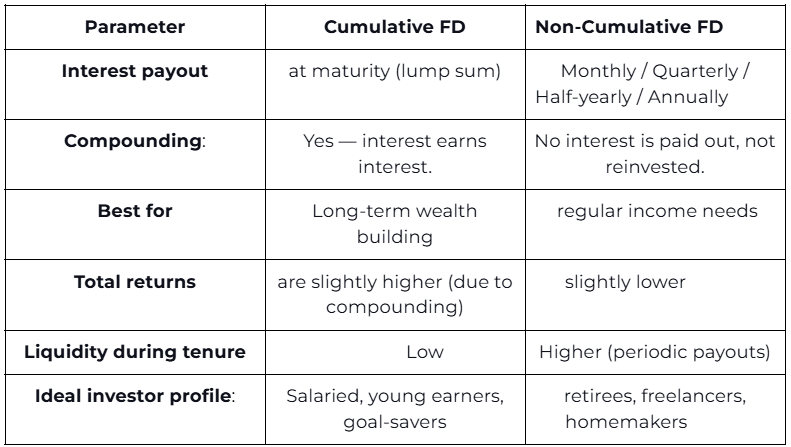
Three Mistakes People Make When Choosing an FD Type
1. Choosing cumulative because the maturity amount looks bigger
It does look bigger — because it includes compounded interest. But if you need a monthly income, that number sitting locked for five years does not help you pay your electricity bill. Match the FD type to your actual cash flow needs, not to what looks impressive.
2. Taking non-cumulative and spending the interest payout
If your monthly interest arrives in your account and you spend it on lifestyle expenses rather than reinvesting it, you have essentially killed your compounding potential and gained nothing strategically. Non-cumulative FDs are for income needs, not for creating the illusion of passive income you then consume.
3. Not considering the tenure
The longer the tenure, the bigger the difference between cumulative and non-cumulative returns. Over a 5-year FD, compounding creates a material gap in the final corpus. With a 1-year FD, the difference isn't as much.
Consider your investment horizon. Here's a Tip: Use Both
You don't have to choose one and live with it. Many investors use a combination:
- A cumulative FD for long-term goals — child's education fund, emergency corpus, retirement savings
- A non-cumulative FD for income support — funding recurring expenses, covering loan EMIs, or supplementing a reduced post-retirement salary
This is sometimes called FD laddering — splitting your investable surplus across multiple FDs with different types and tenures to optimise both growth and liquidity. It is not a complex strategy. It just requires thinking ahead.
Why Muthoot Capital for Your Fixed Deposit?
- Regulated NBFC operating under RBI guidelines
- Presence across 22+ Indian states with 3,250 Cr+ assets under management
- 5.7 lakh+ satisfied customers
- Online FD onboarding — you can open a fixed deposit online without visiting a branch
- FD calculator available on the website to project your exact returns before committing
Whether you want a cumulative FD to build a corpus or a non-cumulative FD to generate regular income through a Muthoot Loan or other financial planning requirement, Muthoot Capital has both on offer.
Ready to Put Your Money to Work?
Muthoot Capital has been a trusted name. Whether you want a cumulative FD to build wealth or a non-cumulative FD to create monthly income, both options are available, and you can open a fixed deposit online in minutes.
Recommended Blogs

Zero Down Payment Bike Loans: How Does the EMI Change?
You've found the bike. The price tag works. Then the dealer asks for a down payment, and suddenly yo...
Read Now
Things to Check Before Financing a Used Car
Most used car loan guides tell you to "check your CIBIL score" and "compare interest rates." Fine, b...
Read Now
How Loyalty Loans Can Help You Secure Lower Interest Rates
You renewed your two-wheeler loan with the same lender you've paid on time for years. Then you got q...
Read Now
Credit Score Ranges Explained for Two Wheeler Loan Applicants
Three digits matter more for your two wheeler loan approval than your salary slip does. For...
Read Now